Carrito
0

El reinicio de un solo material: por qué tres repeticiones hacen que una habitación se sienta tranquila

A algunas habitaciones no les faltan muebles.
Les falta ritmo.
Puedes tener un buen sofá, una alfombra hermosa, una lámpara bien elegida y aun así sentir que la habitación nunca termina de asentarse. Técnicamente no hay nada malo. Simplemente no se siente compuesta.
A menudo, el problema no es que la habitación necesite más cosas. Es que necesita que una sola cosa se repita con intención.
Esto es el reinicio de un solo material.
Elige un material que ya se sienta adecuado en la habitación, luego repítelo tres veces en tres lugares diferentes. No como un conjunto a juego. No como un tema. Como un eco silencioso.
Cuando la repetición es la correcta, una habitación deja de sentirse al azar y empieza a sentirse con autoría.
Por qué la repetición cambia una habitación más rápido que añadir más decoración

La mayoría de las personas intentan arreglar una habitación desconectada añadiendo variedad.
Pero la variedad sin ritmo puede hacer que una habitación se sienta más ruidosa, no más rica.
La repetición es lo que le da al ojo un camino a seguir.
Le indica a la habitación a qué prestar atención. Crea familiaridad sin hacer que el espacio se sienta plano. Es una de las maneras más fáciles de hacer que una habitación se sienta más tranquila, porque el ojo ya no trabaja tanto para entender qué elementos pertenecen juntos.
La textura evita que una paleta tranquila se vuelva plana.
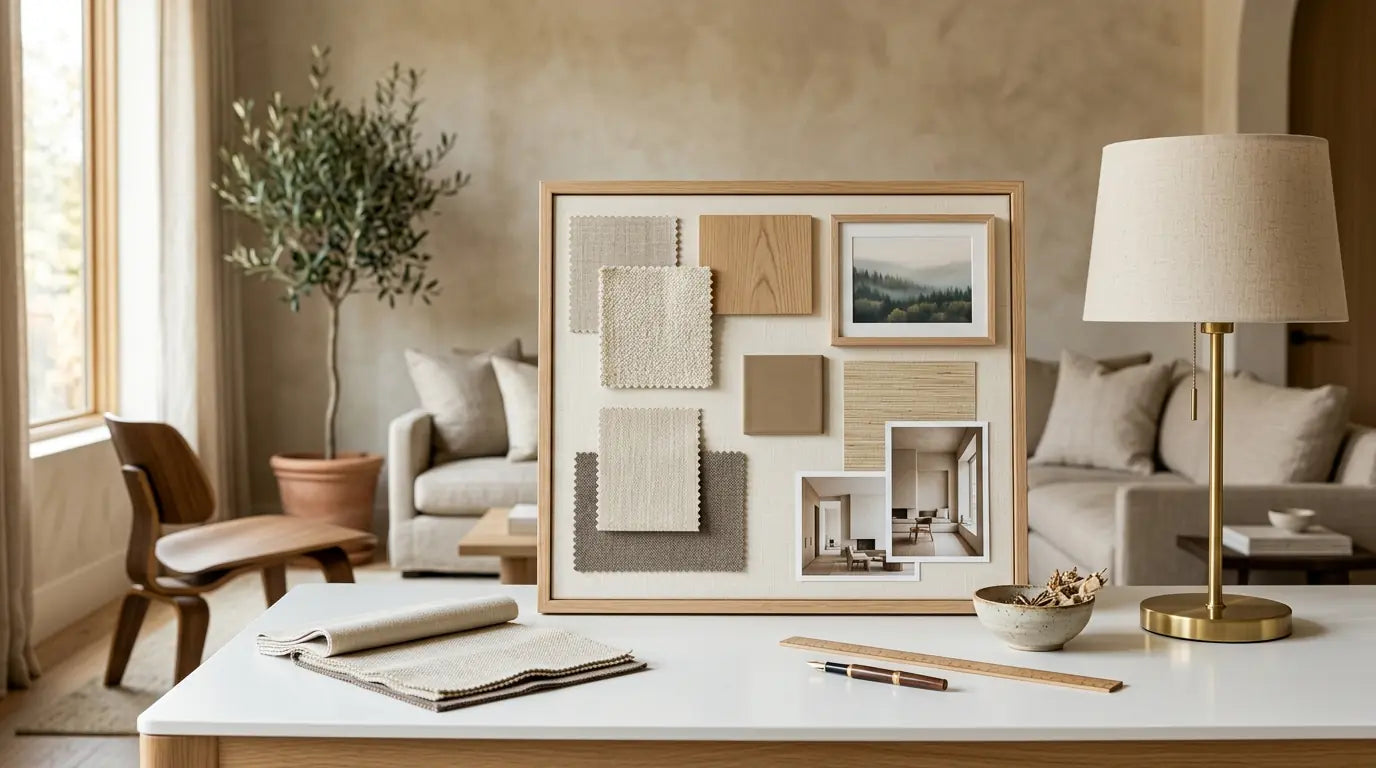
Es por eso que una habitación con lino en las cortinas, lino en una silla y lino en una suave pantalla de lámpara puede sentirse más intencional que una habitación llena de piezas decorativas sin relación entre sí.
Lo mismo ocurre con el nogal, el latón envejecido, la cerámica hecha a mano, el mimbre o la piedra pulida. Un solo material, repetido con moderación, puede enfocar toda una habitación.
Paso 1: Elige el material que ya se siente honesto

El mejor material para repetir no siempre es el más lujoso.
Es el que ya se siente emocionalmente correcto para la habitación.
Si la habitación busca suavidad, ese material puede ser lino, lana o cerámica mate. Si la habitación busca estructura, puede ser nogal, bronce o metal oscuro. Si la habitación busca calidez, puede ser roble pálido, fibra tejida o yeso.
Comienza con el material que se siente nativo a la atmósfera que deseas.
Si la habitación debe sentirse tranquila, elige un material con suavidad o antigüedad. Si la habitación debe sentirse sólida, elige un material con peso. Si la habitación debe sentirse aireada, elige un material que capture la luz suavemente en lugar de reflejarla de golpe.
No estás eligiendo una tendencia. Estás eligiendo una nota.
Paso 2: Repítelo tres veces en tres funciones diferentes

El reinicio funciona mejor cuando el material aparece en tres funciones diferentes.
Una ubicación más grande. Una ubicación de apoyo. Una pequeña ubicación de acabado.
Por ejemplo:
Nogal en la mesa de centro, nogal en el marco de una obra de arte, nogal en un pequeño cuenco en la estantería.
Lino en las cortinas, lino en la silla decorativa, lino en una manta suave doblada una vez sobre el brazo del sofá.
Cerámica en la base de una lámpara, cerámica en un jarrón, cerámica en un pequeño cuenco en una consola.
La habitación no debe leerse como decorada en torno a un truco. Debe leerse como si el material perteneciera naturalmente allí en más de un lugar.
Esto es lo que hace que la repetición se sienta refinada en lugar de obvia.
Paso 3: Deja que las repeticiones varíen en escala

Las tres repeticiones no deben hablar todas al mismo volumen.
Una debe anclar. Una debe apoyar. Una debe susurrar.
Si cada elemento repetido es grande, la habitación empieza a sentirse pesada. Si cada elemento repetido es diminuto, el efecto desaparece. La escala es lo que mantiene la elegancia de la repetición.
La primera repetición le da a la habitación su nota base. La segunda hace que la elección se sienta deliberada. La tercera es la que la hace sentir completa.
Cuando las tres tienen el mismo tamaño o intensidad, la habitación puede empezar a sentirse escenificada. Cuando varían, la repetición se siente natural.
Paso 4: Protege el espacio vacío a su alrededor

El material no necesita estar en todas partes.
Necesita espacio para registrarse.
El espacio negativo es lo que permite que la repetición se sienta tranquila en lugar de abarrotada.
Si cada superficie está llena, el material repetido no se leerá como ritmo. Solo se convertirá en una cosa más en un campo abarrotado. Deja suficiente vacío alrededor de cada repetición para que el ojo pueda notar la conexión.
Esto es especialmente importante con materiales más fuertes como la madera oscura, el latón o el metal ennegrecido. Tienen más peso visual. Necesitan espacio para respirar.
Un material repetido es más poderoso cuando llega, hace una pausa y llega de nuevo.
Cómo saber qué quitar
Si la habitación sigue sintiéndose ocupada después de repetir un material tres veces, la respuesta suele ser la sustracción.
Busca piezas que interrumpan el ritmo sin añadir uno mejor.
Tal vez haya un objeto brillante en una habitación que, por lo demás, es mate. Tal vez hay cinco accesorios pequeños en diferentes acabados tratando de destacar a la vez. Tal vez la habitación ya tiene su historia material, pero dos o tres piezas sueltas la están distrayendo.
Elimina los objetos que no repitan nada significativo.
Quédate con los que refuerzan la nota principal de la habitación.
Es también por esto que el estilo de las superficies importa tanto. Una estantería o una mesa auxiliar puede reforzar la lógica de la habitación o dispersarla. La diferencia rara vez está en la cantidad. Está en la coherencia.
La perspectiva de Inner Union
No creemos que una habitación se sienta completa cuando está llena.
Creemos que se siente completa cuando sabe lo que está diciendo.
El reinicio de un solo material es útil porque reduce la presión. No necesitas reinventar la habitación. No necesitas comprar diez piezas nuevas. Necesitas un material honesto, repetido con suficiente cuidado para que la habitación empiece a hablar con una voz más coherente.
Si tu habitación se siente cerca, pero no terminada, este suele ser el paso que falta.
Antes de añadir más, repite mejor.
Y si después de eso la habitación todavía se siente plana, vuelve al Método de la Escalera de Texturas. La repetición le da ritmo a una habitación, pero el contraste de materiales es lo que le da profundidad.
Explora más piezas en Inner Union Home si deseas construir la habitación desde una historia material más tranquila y consistente.